
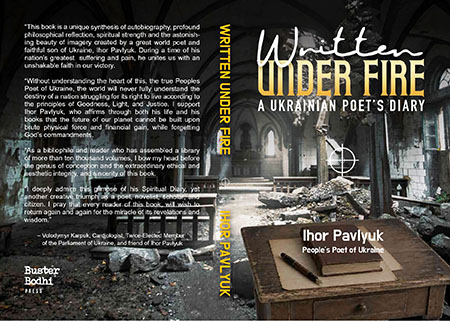
(Pavlyuk Ihor. Writing Under Fire: A Ukrainian Poet`s Diari – USA: Buster Bodhi Press, 2026. – 324 p.)
https://www.amazon.com/Written-Under-Fire-Ukrainian-Poets/dp/B0H1HSK63P
В описані 90 днів із щоденника поета увійшло те основне, чим живе його душа, без деталей неважливих і без найінтимніших моментів усвідомлення, бо ж, за автором, «найглибші механізми творчості мають залишатися частково прихованими». Це додає щоденнику тезовості. Та не поменшує, а поглиблює правдиве зображення стану свідомості конкретної людини в умовах нинішньої війни. Людини, яка живе в межах досяжності нищівних ракет і дронів, ударів інформаційних і щоденного тиску звісток про смерть чи каліцтво близьких, знайомих чи просто такої величезної кількості співплемінників, яку відновити буде надскладно чи взагалі неможливо…
Кожного дня цієї загарбницької війни українці вчитуються у новини: з фронту, що стримує агресора, зі світу, який допомагає, і у напружені – свої внутрішні. І приблизно що три дні довідуються про ракетні чи дронові попадання, не тільки по об’єктах військових й енергетичної інфраструктури, частіше – по наповнених складах провідних українських літературних видавництв, по музеях видатних діячів культури, історичних будівлях, по історичній будівлі будинку письменників (двічі), по бібліотеках, церквах, пологових будинках, багатоповерхівках і невеликих особняках… У «Writing Under Fire» те, можна сказати, залишається поза кадром, як і влучання ракети за декілька десятків метрів від будинку автора. Однак розуміємо, що це усвідомлення не оминає жодну мислячу людину, тим більше письменника, науковця, перекладача, поета чутливого серця, для якого світло долі народу, це і його світло, ба й більше – його призначення, завдання, навіть статус… Автор свідомо зосереджується на тому, що тримає людину, дає снагу до праці, тримає під ним ґрунт у рівновазі, і в цьому його особиста перемога над ворогом, який очікує на протилежне.
На сьогодні Ігор Павлюк є одним із найулюбленіших поетів українців, його віршована творчість за формою і змістом є живою мовою народу. Народу, який твердо стоїть на засадах правоти шляху правди, шанує у собі стержень гідності, береже віру у перемогу добра над злом і глибоко переживає багатовікове пониження українців: «Стоїмо на землі, у ярмі винуваті… / У калиновім гробі історія спить. // Як Отой, що приречений Батьком на страту, / Сонце світить, мовчить» (Із збірки поезій Ігоря Павлюка «Спас»).
У поетиці цього автора – гострий біль надірваної травинки і висота глибин Молочного Шляху, неодмінна узагальнююча краса думки на тлі пронизаних чуттям фраґментних малюнків антуражу, символи, що схиляють до прозрінь, і почасти така неймовірна образність, яка викликає захоплення ще до повного усвідомлення усіх підтекстів сказаного. Поет пронизуючої, інколи батяркуватої відвертості. У пресі його позиціонують як одного із найпомітніших постатей сучасної української літератури, його доробок оцінений декількома міжнародними і численними українськими літературними преміями, серед яких і престижна Народна Шевченківська премія.
Голос Ігоря Павлюка чутний і розпізнаваний в Україні і за її межами, зокрема у нинішньому воєнному часі, часі масштабного наступу зла. «Як залишитися людиною, коли світ розпадається? Я не даю остаточних відповідей. Я лише свідчу», – каже поет. Тільки тоді, коли відчуваю і розумію, що є на своєму місці і роблю усе, що потрібно для повернення благодатної основи для життя людей, моє серце входить у стабільний відносний спокій навіть в умовах війни, – прочитуємо поміж рядками. Більше того, воно сповнюється внутрішньою радістю через усвідомлення того остаточного фінішу, який дає правильний вибір шляху.
Завданням справжнього поета, який тонко відчуває стан світу, є не тільки стабілізація його, світу, в умовах розпаду морального, духовного чи навіть фізичного, – він лікує людські душі, відновлює, збудовує їх заново. «Коли збігаються три зими – календарна зима, зима мого життя і, як іноді мені здається, зима людства – народжуються рядки, які допомагають мені жити. І я сподіваюся, що вони можуть стати ліками для когось іншого», – читаємо у передмові автора.
Окрім загрози зовнішньої смерті є щось складніше – загроза смерті внутрішньої. У нинішній війні агресор реально вбиває і катує інакомислячих, займається розбоєм і крадіжками, визискує українців на захоплених територіях, проявляє необґрунтовану ненависть і найгірше – переводить завойованих силою і обманом у свою ницу ідеологію. Коли ворог із найсерйознішим виглядом втілює у життя народів, нав’язує і виправдовує свою риторику домінування сили і стосунків на її основі, підтверджуючи її величезною кількістю убитих, то, мовить Ігор Павлюк, «сама природа реальності починає змінюватися». Але «справжня боротьба відбувається не зовні, а всередині». У цей час «свідомість шукає опору», її обирає і зафіксовує кожен зокрема. І «якщо впустити довіру до Бога, навіть найважчі обставини не можуть зламати внутрішній стрижень», – каже автор.
Для Ігоря Павлюка духовна тематика – не відкриття під час війни. У ній він – усе своє життя, спочатку не усвідомлено, а потім і свідомо. Від часу, коли себе пам’ятає, завжди не вистачало чогось вагомого. Коли йому було лише 10 днів, померла мама. Його виховували бабуся з дідусем. Відчуття непоправної втрати залишилося на все життя. «Журба – це любов, що навчилася жити із порожнечею» – каже у своїх тезах духовного пошуку.
Згодом гостра потреба когось неприсутнього люблячого, вірного і опікуючого перенеслася на особу Бога. Та й і нині поет жартівливо називає себе старіючим хлопчиком із ліричним сирітським серцем. Без батьків від дитинства залишився і найвеличніший український поет Тарас Шевченко, щоби в сукупності з іншими злигоднями вигострився потаємний інструмент пера – його серце. Страждання від недосконалості світу породжують потребу його вдосконалити, проте аж ніяк не силовим методом, а звертаючись до серця і розуму людини, змінюючи себе любов’ю і випромінюючи її у світ.
Дитинність дозволяє зберігати чистоту душі, й Павлюк по-дитинному відкритий, незважаючи на те, що завжди знайдуться любителі потоптатися за надмірно, на їхню думку, відкритими дверми.
Та творчість, це праця і нагорода одночасно. У ній – сам автор, його сутність, його осяяння, душевні й духовні здобутки. І розкриваючи їх іншим, він стає щасливим, бо в цьому – завдання справжнього поета. Справжній поет відзначається і граничною щирістю: «Краще казати істину, яка приносить біль, а потім зцілює, ніж говорити брехню, яка заспокоює, а потім убиває».
Дружина Людмила (Злата) Павлюк, поетеса, із жартівливою правдивістю зауважує чоловікові: «Як для поета справжнього, Ти людина адекватна». Однак сам поет вважає себе «незручним»: тим, «кого неможливо вписати у готову рамку, використати як символ або безболісно ігнорувати».
Кожен із 90 днів щоденника, розпочатий короткими даними про основну подію дня, його кредо, реалії війни і діяльність автора продовжується інформуванням про те, що для нього стало найважливішим. А це – короткий опис яскравої події, думки́ до духовного щоденника «Богоєднання», власний вірш або радісне повідомлення про вихід у світ своєї нової книжки з обов’язковою реакцію друзів із соцмереж, чи просто публікація у ЗМІ про себе, якою ділиться із читачами «Писання під вогнем».
У вірші, зашифрованому темами, під- і надтемами, відбивається сутність автора, перегукується із сердечними нотками читачів, переважно також поетів, закладається інформаційно. Авторові потрібно відчувати, що його слово працює. Розсипи світла вищого порядку у сірому застої приземистих світських зацікавлень на тлі Павлюкової майстерності, це також і радість спілкування поезією. Обмін приязню при знаходженні спільного світлого, доброго й гідного, це також любов. Обмін любов’ю, це обмін живим життям на тлі некрофільної війни.
Подією, що удостоїлася згадки, може бути розмова автора про життя після смерті чи роздуми про матеріалістичний вимір духовного через найдрібніші частки атомарного порядку, його відвідування батьківського краю і спілкування з краянами чи перепост про загибель на фронті українського поета. Усе спрямовує читачів від короткозорості сприйняття світу у вектор бачення вічності, у ріст цінностей від низького й дріб’язкового до високого і великого. Подекуди, як і в Павлюкових віршах – торкається серця, привідкриває його виміром глибокої доброти.
Ігор Павлюк вважає, що «енергетика твору триєдина за метафізичними законами: сплав біографії, тексту та фото письменника». Існує думка, що твори письменника тісно пов’язані із особистістю свого творця, і такими залишаються навіть після його переходу за межу земного життя, а міра життя самих творів визначається висотою духу їхнього автора. У цьому контексті біографія автора – земне відображення його сили духу. Після цих слів чомусь згадується Павлюкове: «Ніде було ховатися від грози у дитинстві. Ось і перестав боятися…» чи «Велика ніч. / Роздягаюся перед вогнищем – / Щоби вороги / Побачили / Моє тіло… // Помру – / Щоби друзі / Побачили / Мою / Душу» (Із збірки поезій Ігоря Павлюка «Спас»).
Введені у «Писання під вогнем» тези до духовного щоденника «Богоєднання», які поет формулював у відповідний день, відображають світогляд автора і розвиток його духовності у прагненні наближення до Бога світла і добра і злиття з Ним у богоєднанні.
У котромусь із висловів «Богоєднання» Павлюк признається, що лише недавно усвідомив, що його життєвим призначенням було стати письменником. Однак, трепетно ставлячись до теми реалізації себе як поета, письменника, свій духовний шлях усе ж вважає важливішим: «Ми засвоїли форму, але втратили зміст віри! Діло поета – повернути її людям», «Я пишу так, ніби рятую чиєсь життя. Можливо, моє власне» (Кларісе Ліспектор), «Моя місія: збільшення духовності в собі і у світі».
У книжковому виданні «Богоєднання» він, уже відома людина з науковим званням доктора наук із соціальних комунікацій, професора, виступає стійко віруючим і релігійним. Його тези – шлях вдосконалення духу через православ’я, новітні наукові дослідження, що пересікаються із темою духовності, а також особистий досвід. Самозаглиблюється у молитву як провокацію спілкування зі світлими небесними силами, зокрема й зі своїм ангелом-охоронцем. У цьому спілкуванні викристалізовуються його роздуми. Вони впливають на Павлюка-людину, Павлюка-поета, Павлюка-науковця…
І справді, у «Богоєднанні» відчувається стійкий поступальний очищувальний ефект для читача у міру росту автора – від менш до більш зрілих пошуків духовного вдосконалення. Читач крокує разом із письменником (при віддаленості, розриві цієї ходи читач і не зацікавився б!), і сходинками до досконалості виступають також і помилки росту. Це «шлях крізь темряву, яким одного дня зможуть пройти інші. Там важливо не те, скільки написано, а чи залишився він носієм світла» – таким є висновок ШІ про автора «A Ukrainian Poet`s Diari» з його ж таки подачі у Післяслові. Якщо є очищення, то є і світло. А якщо є світло, то є і здоров’я.
Цікаво, що катарсисом називає не власне внутрішнє перепалювання духовних недосконалостей, а виписування і видрук книжок, а отже, потенційне очищення своїх читачів.
Автор «A Ukrainian Poet`s Diari» прагне знати, що його почули, чи не тому для нього так важливо мати безпосередній відгук свого читача, комунікувати? Йому потрібно щось мати (не маючи з дитинства матері), і через своїх прихильників він має упевненість у виконанні свого призначення. Йдучи попереду, оглядається, щоби не відірвати дистанцію від своєї широкої аудиторії, щоби знати, що його сприймають, розуміють, захоплюються, що читають. Постійно перевіряє себе: так, тут мої справи добрі. Це своєрідний звіт перед Богом. Однак, на межі з марнославством. Чи так важливо відчувати любов від світу? Не кажу «так» чи «ні». Кажу: варто подумати, можливо, викристалізуються деякі нюанси.
Внутрішній хід духовного поступу кожної людини, утім, як і народу чи людства загалом, подібний на рух космічних тіл – по спіралі і за годинниковою стрілкою (зліва направо, якщо до Бога, а не від нього). Щодо напрямку в Павлюка є чудовий жартівливий вислів: «Справи йдуть чудово, але не відомо куди…».
В устремлінні своїм об’єкт руху поступово набирає висоти і непомітно звужує коло спіралі обльоту. Якщо він веде за собою інших, то стількох, скільки подужає підняти, одночасно перебуваючи із ними у взаємозв’язку. Звичайно, має значення кількість зацікавлених, та ще більше приваблює швидкість і висота руху у правильному напрямку. У нинішніх реаліях активізуються і потребують розвитку саме категорії швидкості і висоти. І це відкрито поету чутливого серця.
Поет вбирає, пропускає крізь себе страждання, власні і народу, і віддає словами, які відкривають серце. Вбирає удари і оповідає бачення і розуміння. Вбирає біль і висвітлює усвідомлення необхідності добра. Пробудно і тверезо. Як і вся Україна.
У Вступному слові автор повідомляє, що дев’яностоденний щоденник вкладається у проміжок між релігійними святами Різдва і Благовіщення. Перша третина цього проміжку є для нього часом особливої емоційної насиченості та глибоких переживань, пов’язаних із родинною пам’яттю та сімейними святкуваннями. Нагода задуматися над болем минулого, над тими умовами і можливостями, які створювала доля, над особистою віддачею себе шляхам, вибраним провидінням і над прийдешніми його несподіванками. Одним словом, над власною історією.
Історія України, це історія болю. Задавненого, несправедливого, подвижницького у дусі своєму, миротворчого. В духовній генетиці України-Русі (не плутати з Росією!) нема інформації про можливість загарбницької війни. Там прописані повага до інших народів, життя у взаємній підтримці і певній жертовності заради підняття усіх щаблями вдосконалення, розвитку загальновизнаних людських цінностей, у тому числі моральних і духовних. Реалізація таких якостей можлива у світі, який не йде на поступки злу у собі самому, як би не було важко. Поет завжди безкомпромісний щодо зла. Людина серця завжди обирає прийдешнє добро.
Йдучи через зиму календарну, особисту, свого народу чи всього світу, мусимо пам’ятати про сонячні дні. Різдво – прихід Добра у недосконалий світ, якому цей світ противиться. Перше свято по тому – виживання у недосконалому світі, початок нового року. Релігійне свято Богоявлення символізує утвердження Добра у світі і виявлення себе у ньому. Стрітення – розуміння і прийняття Добра іншими. Врешті, по деякому часі – Благовіщення Богородиці. Мале коло спіралі життя замикається, бо ж воно несе розуміння приходу Різдва. Однак усвідомлюємо, що на новому витку спіралі воно стане народженням Добра в серцях багатьох.
Віриться, що, попри важкі часи виживання фізичного, державного, економічного, сутнісного і духовного, Україна уже входить у сферу світла свого Благовіщення. Поки воно неясне, та з часом набиратиме яскравості аж до повного відкриття світові. При світлі відкривається правда і показуються усі недоречності, приховані незнанням. І кожен розуміє, що набагато краще і безпечніше жити у світі Добра.
Анна-Віталія Палій
IHOR PAVLYUK: BETWEEN SUFFERING AND GOODNESS
(Pavlyuk, Ihor. Writing Under Fire: A Ukrainian Poet’s Diary. USA: Buster Bodhi Press, 2026. 324 p.)
The ninety days chronicled in this diary distill the essential realities that sustain the poet’s inner life. Deliberately absent are trivial details and the most intimate moments of self-revelation, for, as Pavlyuk himself observes, “the deepest mechanisms of creativity must remain partly hidden.” This deliberate restraint lends the diary an aphoristic, meditative quality without diminishing its authenticity. On the contrary, it deepens the truthful portrayal of an individual consciousness struggling to remain whole amid the realities of Russia’s ongoing war against Ukraine.
The narrator lives within the reach of missiles and drones, under the relentless assault of information warfare, and beneath the daily burden of news reporting the deaths and injuries of relatives, friends, acquaintances, and countless fellow Ukrainians whose losses may never truly be repaired. Yet the diary resists becoming a chronicle of destruction. Instead, it records the inner mechanisms of survival.
Every day of this war of aggression, Ukrainians scan the headlines – from the front lines where soldiers hold back the invader, from the international community offering support, and from the battlefield within their own minds. Every few days, they learn of another missile or drone strike – not only against military or energy infrastructure, but against warehouses filled with books from leading Ukrainian publishers, museums dedicated to prominent cultural figures, historic landmarks, the historic Writers’ House (struck twice), libraries, churches, maternity hospitals, apartment buildings, and family homes.
In Writing Under Fire, however, much of this devastation remains beyond the frame. Even the missile that landed only a few dozen meters from the author’s home receives little direct attention. Yet its presence permeates every page. Such awareness cannot escape any thoughtful person, least of all a writer, scholar, translator, and poet whose sensitive heart experiences the fate of the nation as inseparable from his own calling. For Pavlyuk, the light – or darkness – of his people’s destiny becomes his own responsibility, his vocation, even his identity.
Instead of dwelling on destruction, the author consciously turns his attention toward what enables a person to endure: what restores inner balance, sustains creative work, and preserves human dignity. In doing so, he achieves a deeply personal victory over an enemy whose ultimate aim is spiritual collapse.
Today Ihor Pavlyuk stands among Ukraine’s most beloved contemporary poets. Both formally and thematically, his poetry speaks in the living language of the Ukrainian people – a people firmly committed to truth, determined to preserve their dignity, steadfast in their belief that good will ultimately triumph over evil, while carrying the historical burden of centuries of oppression:
We stand upon the earth, guilty beneath the yoke…
History sleeps inside a coffin made of viburnum wood.
Like the One condemned by the Father to execution,
The sun shines on – in silence.
(From Pavlyuk’s poetry collection Savior.)
Pavlyuk’s poetics unite the pain of a broken blade of grass with the vastness of the Milky Way. His work combines philosophical breadth with emotionally charged fragments of lived experience, weaving symbols that invite revelation and imagery so powerful that it inspires admiration even before all of its meanings have been fully understood. His poetry is marked by piercing sincerity – at times disarmingly playful, even mischievous, yet always profoundly honest.
Literary critics consistently recognize Pavlyuk as one of the defining voices of contemporary Ukrainian literature. His work has received numerous national and international distinctions, including the prestigious People’s Shevchenko Prize.
His voice is heard not only throughout Ukraine but increasingly beyond its borders, particularly during this historical moment when the world confronts an unprecedented resurgence of violence and moral darkness.
“How does one remain human when the world is falling apart? I offer no final answers. I simply bear witness,” the poet writes.
Between the lines, one senses another conviction: only when a person recognizes that they occupy their rightful place in the world and devote themselves to restoring the foundations upon which human life depends can the heart recover even a fragile peace amid war. More than peace, it discovers an inner joy born of knowing that one has chosen the right path.
The vocation of a genuine poet – one who possesses an unusually acute awareness of the world’s condition – is not merely to stabilize a fractured reality, whether morally, spiritually, or physically. The poet heals wounded souls, helping rebuild what violence seeks to destroy.
As Pavlyuk writes in the book’s preface:
“When three winters converge – the winter of the calendar, the winter of my own life, and, at times it seems, the winter of humanity itself – lines are born that help me continue living. I hope they may become medicine for someone else as well.”
Yet beyond the threat of physical death lies something even more devastating: the danger of inner death.
In this war, the aggressor not only kills, tortures, loots, and terrorizes civilians. It also seeks to reshape consciousness itself, forcing conquered people into an ideology built upon domination, violence, and deception. When such brutality begins to define reality, Pavlyuk observes, “the very nature of reality begins to change.” Yet, he insists, “the true struggle takes place not outside us, but within.”
At such moments, “consciousness searches for something to hold onto.” Each individual must choose that foundation for themselves. For Pavlyuk, the answer is unmistakable:
“If one allows trust in God to enter the heart, even the harshest circumstances cannot break one’s inner core.”
For Pavlyuk, spiritual reflection is not a discovery brought about by war. It has been the central current of his life from the beginning – first unconsciously, later with deliberate awareness. Since childhood he has carried an unfillable absence. His mother died when he was only ten days old, leaving him to be raised by his grandparents. That irreparable loss became a permanent part of his inner landscape.
“Grief is love that has learned to live with emptiness,” he writes in his spiritual meditations.
Over time, the longing for an absent yet loving and faithful presence gradually found its fulfillment in God. Even today, Pavlyuk jokingly refers to himself as “an aging boy with the lyrical heart of an orphan.”
The greatest Ukrainian poet, Taras Shevchenko, also lost his parents in childhood. For both writers, suffering became the hidden instrument through which the heart was sharpened into an instrument of artistic truth. Awareness of the world’s brokenness awakens not the desire to conquer it through force, but the calling to transform it through love – by appealing to the human heart and mind, beginning with one’s own inner transformation.
Childlike openness, Pavlyuk suggests, preserves the purity of the soul. Despite inevitable criticism from those who mistake openness for weakness, he remains remarkably transparent in both life and literature.
For him, creativity is both labor and reward. His work embodies his very being – his revelations, emotional experience, and spiritual discoveries. Sharing them with others becomes a source of profound happiness because this, he believes, is the true vocation of every authentic poet.
And authenticity, for Pavlyuk, demands radical honesty:
“It is better to speak a truth that hurts and eventually heals than to tell a lie that comforts only to destroy.”
His wife, the poet Liudmyla (Zlata) Pavlyuk, once remarked with affectionate irony:
“For a true poet, you’re surprisingly well adjusted.”
The poet himself smiles at the observation but describes himself differently – as someone “who cannot be fitted into a ready-made frame, turned into a symbol, or conveniently ignored.”
Each of the diary’s ninety entries begins with a brief record of the day’s central event, its guiding principle, the realities of war, and the author’s activities. It then turns toward what mattered most to him that day: a vivid personal encounter, reflections later incorporated into his spiritual diary Union with God, a newly written poem, joyful news of another published book accompanied by readers’ responses on social media, or a newspaper article that he shares with the readers of Writing Under Fire.
The poem itself – layered with themes, subthemes, and overarching motifs – reveals the author’s deepest essence while resonating with the emotional sensibilities of its readers, many of whom are poets themselves. Through these interconnected layers, meaning unfolds gradually, inviting reflection rather than immediate interpretation. Pavlyuk needs to know that his words continue to live and work within those who read them. The scattered flashes of higher light that illuminate the gray stagnation of everyday worldly concerns are themselves part of the joy of poetic communion. The exchange of friendship that grows from recognizing what is noble, good, and luminous in another is itself an expression of love. And the exchange of love becomes an exchange of life itself against the backdrop of a war driven by death.
A single diary entry may center on a conversation about life after death, reflections on the material dimension of the spiritual world through the smallest structures of atomic reality, a visit to the poet’s native land and encounters with fellow villagers, or the news of a Ukrainian poet killed at the front. Whatever its immediate subject, each episode gently redirects the reader from the short-sightedness of daily perception toward the horizon of eternity, inviting a movement from the trivial and ephemeral to what is enduring and profound. As in Pavlyuk’s poetry, these moments frequently touch the heart, opening it to a deeper experience of goodness.
Pavlyuk himself believes that “the energy of a literary work is metaphysically threefold: it is a fusion of the writer’s biography, the text itself, and the writer’s photograph.” There is a long-standing belief that a writer’s works remain inseparable from the personality of their creator, even after the author has passed beyond earthly existence, and that the life of those works ultimately depends upon the height of the author’s spirit. Within this perspective, biography becomes the earthly manifestation of spiritual strength.
One cannot help recalling Pavlyuk’s own words:
“There was nowhere to hide from thunderstorms in my childhood. So I simply stopped being afraid.”
Or these lines from his collection Savior:
A great night.
I undress before the fire
So that my enemies
May see
My body…
I shall die
So that my friends
May see
My
Soul.
The reflections from Pavlyuk’s spiritual diary Union with God, incorporated into Writing Under Fire, reveal the evolution of the author’s worldview and his lifelong search for union with the God of light and goodness. Written day by day, these concise meditations trace the gradual deepening of his spiritual life.
In one of these reflections, Pavlyuk confesses that only recently did he fully realize that his life’s calling was to become a writer. Yet, despite his profound devotion to literature, he considers his spiritual journey even more important than his literary vocation:
“We have mastered the form but lost the essence of faith. The poet’s task is to restore it to humanity.”
He also quotes Clarice Lispector:
“I write as though I were saving someone’s life. Perhaps my own.”
And then defines his own mission with remarkable simplicity:
“My mission is to increase spirituality within myself and in the world.”
In the published volumes of Union with God, Pavlyuk appears not only as a distinguished scholar – a Doctor of Social Communications and university professor – but also as a man of profound and unwavering religious faith. His reflections describe a path of spiritual refinement shaped by Orthodox Christianity, contemporary scientific inquiry intersecting with questions of spirituality, and personal experience. Prayer becomes for him not merely a religious practice but an invitation into dialogue with the forces of divine light, including what he understands as the presence of his guardian angel. Out of this dialogue emerge the reflections that shape Pavlyuk the man, Pavlyuk the poet, and Pavlyuk the scholar.
Indeed, Union with God possesses a cumulative, quietly purifying effect. As the author matures spiritually, readers accompany him from earlier, less mature reflections toward increasingly profound insights. They advance alongside the writer; without this shared journey, the book would lose much of its compelling power. Even the inevitable mistakes encountered along the way become meaningful steps toward spiritual growth.
In the afterword to Writing Under Fire, artificial intelligence offers a striking observation about the author:
“It is a path through darkness that others may one day follow. What matters is not how much has been written, but whether the traveler has remained a bearer of light.”
If there is purification, there is light. And where there is light, there is healing.
Interestingly, Pavlyuk understands catharsis not primarily as an inward burning away of spiritual imperfections but as the act of writing and publishing books – an endeavor through which the purification of the author may become the purification of his readers.
The author of Writing Under Fire longs to know that he has truly been heard. Perhaps this explains why direct dialogue with readers and their immediate responses matter so deeply to him. Having lost his mother in infancy, he continues to seek a form of affirmation, and through his readers he finds reassurance that his vocation has meaning. Though he walks ahead, he frequently looks back – not from uncertainty, but to ensure that he has not become separated from those who travel with him. He wants to know that he is understood, read, and appreciated.
In a sense, this ongoing dialogue resembles a report offered before God. Yet it also raises a subtle question, hovering on the edge of vanity: How important is it to feel loved by the world? The review offers no definitive answer. It merely invites reflection.
The inner movement of spiritual development – whether of an individual, a nation, or humanity itself – resembles the motion of celestial bodies: a spiral rising ever upward. For Pavlyuk, the direction of that movement matters above all else. His characteristic humor captures this paradox:
“Everything is going wonderfully – I’m just not sure where it’s going.”
As any object advances toward its destination, it gradually gains altitude while the circles of its spiral become ever tighter. If it leads others, it can raise only as many as it is capable of carrying while remaining connected to them. Numbers matter, but what matters even more are the speed and elevation of movement in the right direction. In today’s world, these qualities – spiritual altitude and moral acceleration – have become urgently necessary. Pavlyuk’s poetic sensibility recognizes this with uncommon clarity.
The poet absorbs suffering – his own and that of his people – and returns it transformed into words that open the human heart. He absorbs violence and responds with understanding. He absorbs pain and reveals the necessity of goodness. He writes with wakeful clarity and moral sobriety, much like Ukraine itself.
In the book’s introduction, Pavlyuk explains that his ninety-day diary spans the period between Christmas and the Feast of the Annunciation. For him, the first third of this journey is marked by especially intense emotions connected with family memory and the traditions of Christmas. It becomes a time for contemplating the wounds of the past, the circumstances through which destiny has shaped one’s life, the paths chosen under providence, and the unexpected turns that still lie ahead. In short, it is a meditation upon one’s own history.
The history of Ukraine is, above all, a history of suffering – ancient, unjust, yet spiritually resilient and fundamentally peace-seeking. Within the spiritual heritage of Kyivan Rus’ – not to be confused with Russia – there exists no tradition that legitimizes wars of conquest. Instead, it embodies respect for other peoples, mutual support, and a willingness to sacrifice for the common good and the advancement of universal moral and spiritual values. Such ideals can flourish only in a world that refuses to compromise with evil, however difficult that refusal may be. The true poet never compromises with evil. A heart awakened to truth invariably chooses the coming of goodness.
As humanity journeys through the winter of the calendar, the winter of personal life, the winter of a nation, or even the winter of civilization itself, it must never forget the promise of sunlight. Christmas signifies the entrance of Goodness into an imperfect world that resists it. The New Year marks the continuation of life within that imperfect world. The Feast of the Epiphany symbolizes the manifestation of Goodness in history. The Presentation in the Temple represents humanity’s recognition and acceptance of that Goodness. Finally comes the Annunciation – the promise of new life.
The small spiral of the liturgical year closes only to begin again on a higher turn, where Christmas is no longer merely remembered but reborn within countless human hearts.
Despite the immense challenges confronting Ukraine – physical, political, economic, existential, and spiritual – one senses that the nation is already approaching its own Annunciation. Its light may still appear faint, yet it continues to grow brighter, preparing eventually to reveal itself fully to the world. In that light, truth becomes visible, illusions disappear, and what ignorance once concealed is brought into the open. Then it becomes clear that there is no safer, wiser, or more deeply human place to live than within the realm of Goodness.
Anna-Vitaliia Palii
Leave a Reply